Where Is Your Park Fighting? Four Competitive Battlefields in the Indoor Play Business
- Share
- publisher
- Katherine Zhang
- Issue Time
- Sep 9,2026
Summary
Four competitive battlefields for indoor play parks: downtown mall, product‑driven, efficiency‑focused and community‑based. Find your advantage and build your moat amid industry changes.
Talk to anyone running an indoor play venue lately and you will hear the same sentence: it keeps getting harder. Not because owners stopped working. Because the world around the business keeps moving — shopping habits, competition, retail traffic — all at once, and most of it outside anyone's control.
Working harder at the same things is not the answer. The useful question is more basic: which battlefield is your park actually standing on? We have sat with investors in city-center malls, suburban complexes, community strips, and tourist towns. They all operate indoor play venues, and their competitive situations could not be more different. A strategy that wins on one field can fail outright on another. Four types cover most of what we see, and the first move is honest identification.
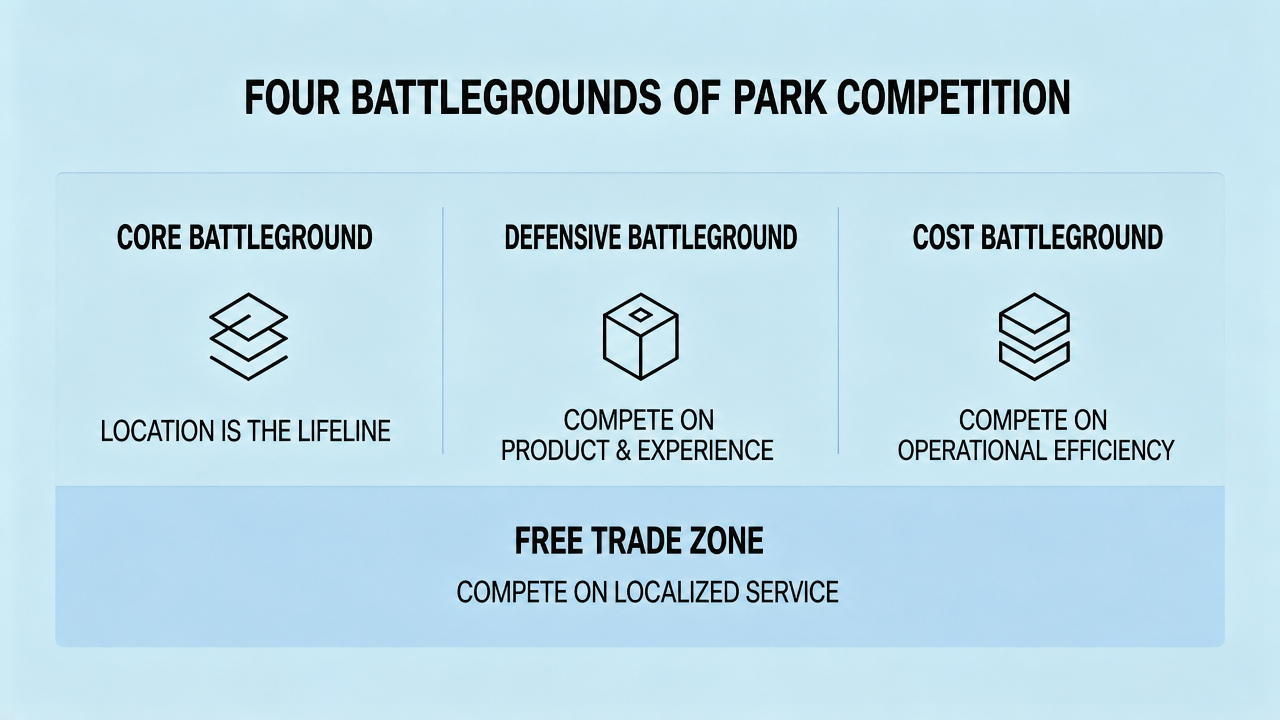
The Core Battle: Location Is the Lifeline, and the Trap
A park in a city's central shopping district holds one overwhelming asset: the address. Traffic arrives by itself, marketing spend stays low, and weekend lines form without effort. Walk into one of these on a Saturday and it looks like the easiest business in the world.
The same address is also the exposure. When the mall rebalances its tenant mix, when a bigger competitor opens two floors away, or when the mall's own traffic softens, the park absorbs it with no buffer at all. Owners in this position tend to believe the location will save them. The ones who actually endure treat it as a starting point and build on top: long leases that lock the position in, service deep enough that families come deliberately rather than incidentally, and a membership system that slowly converts mall foot traffic into a customer base the mall does not own. Location starts the game. It does not finish it.
The Defense Battle: Product Depth Nobody Can Copy
Some parks sit on average addresses but carry something distinctive — a serious ninja-course operation, a reputation for themed birthday parties, a children's fitness program with actual structure. Their customers do not wander in. They arrive on purpose.
The vulnerability in this position is imitation, and it moves fast. Launch a party concept that works and the venue next door copies it within weeks. Import a new attraction and competitors place the same order with the same supplier.
The defense is depth, and it comes in three layers. Keep iterating, so that by the time someone copies your current version you have already shipped the next one. Polish the service details, because equipment can be purchased and a trained team cannot. Build your own identity, so children ask for "this park" rather than "this equipment."
A pattern shows up across the industry that supports all three. Some parks run machines that are visibly older than the competitor's, and parents still bring their children every week. Stand at the entrance long enough and the reason appears: the coaching staff knows the kids by name, the curriculum is original, and the children are measurably better at something than they were a month ago. Anyone can buy the hardware. The system around it is what cannot be ordered from a catalog.
The Cost Battle: Efficiency as a Moat
A third group of parks holds ordinary locations and unremarkable products, and wins anyway on the economics. Lean staffing, low rent, disciplined operations, and a price position the neighbors cannot easily match.
The vulnerability here is that the advantage erodes from both ends. Wages rise, rents climb, a rival starts discounting, and the margin compresses before the owner notices.
The defense is unglamorous and effective. Shift schedules built around actual traffic curves so the smallest viable team covers the floor. Standardized processes that strip out waste and rework. Tools that remove labor from routine work — online booking, self-service redemption, digital records instead of clipboards.
We have watched parks in smaller cities run modest spaces with nothing special on the floor, and quietly out-earn bigger neighbors. The owner manages every line item with unusual discipline — same revenue, notably higher margin. Efficiency is a moat, and unlike location it does not depend on anyone else's decisions.
The Free Trade Zone: Relationships Are the Whole Business
The fourth battlefield is the community park, serving families within a few kilometers. No mall traffic to borrow, no signature product to advertise. What these venues have is proximity and familiarity, and what threatens them is churn — a new park opens nearby, a loyal family moves away, and the revenue dips with no obvious replacement.
The winning play here has nothing to do with attractions. It is becoming the neighborhood's default family destination. Partner with local kindergartens and training centers until the park is their outdoor classroom. Run member events until parents describe the place as part of their child's growing up. And do the unglamorous work of remembering — names, favorite games, which child needs a hand getting onto the high platform.
Among community parks, the ones that live the longest are rarely the ones with the newest equipment. The owner knows every regular kid, a parent leaves a message in the group chat asking for a spot to be held, and it is done without discussion. That kind of trust cannot be bought with any budget.
What the Operators Who Made It Work Have in Common
Across more than 60 Pokiddo venues, roughly 70% reached payback within 6 to 18 months, and the strongest did it in under a year. Sit with enough of those investors and three habits surface repeatedly.
First, they knew what they had before they decided what to do. The successful parks are neither the most expensive nor the cheapest in their market; they are the ones with an accurate answer to the question "what is my actual advantage?" A location-led park squeezes service quality. A product-led park keeps refreshing. A community park invests in neighbor relationships until local families call it their own. Most owners ask "what should I do?" The better first question is "what do I actually have?"
Second, they checked the wind before chasing the trend. This industry stampedes. Trampolines get hot and every street gains a trampoline venue; parties get popular and everyone launches party packages. Chasing a wave is not automatically wrong — but the parks that last are rarely the fastest movers. They are the ones that already held something in hand when the wave arrived. A useful test: will what I am doing today still be worth something in three years? If the honest answer is "it is just popular right now," the follow-up question is what happens when popularity fades.
Third, they did not try to carry it alone. Site selection, construction, equipment, hiring, operations, programming — any single one of these can exhaust an owner. The operators who run profitable parks comfortably are not necessarily the most capable people in the room; they are the best at finding capable help. Bring in specialists for what you cannot master, adopt operating systems that are already proven, and talk to people who have made the mistakes you are about to make. That last part is essentially what Pokiddo exists for — not to make decisions for investors, but to let them decide with more certainty than we had.
Change Is a Reshuffle, Not a Threat
The industry is changing, and change is not the enemy. Change is when the deck gets reshuffled, and the operators who benefit are the ones who saw their battlefield clearly, identified the moat available to them, and dug it deeper before the market forced the question.
Competitive analysis should come before architectural decisions. When you are researching how to start a trampoline park, the first question is which battlefield you are entering: a city-center venue and a neighborhood venue face different opponents and need different strategies, and copying a successful park's playbook without locating your own position is how capital gets misallocated. The indoor trampoline park design should follow the same logic — a location-led park may favor spectacle and large group flow, while a community park may need flexible zones for classes and parties.
The trampoline park equipment you select belongs to your strategy, not to a supplier's catalog. The trampoline park cost figure means nothing until it is measured against the revenue model your position can actually support. And when investors weigh the trampoline park franchise cost against working directly with a trampoline park manufacturer, the deciding question is usually whether the partner understands operating strategy or simply supplies hardware. As a trampoline park manufacturer operating venues on several continents, we have watched all four battlefields from the inside. The parks that win are the ones that knew which war they were fighting.
Find your battlefield. Build your moat. Keep digging.